Puppy Leash Training: The Gear Nobody Explains (and the First Walks)
Here's something no one told me before our dog Bulka's first walk: a puppy who pulls, freezes, or panics on the leash is usually telling you something about the gear, not about their character. Get the harness, the leash, and one surprising measurement right, and half the "walking problems" people brace for simply never show up.
The good news is that none of this is expensive or complicated. It's just a handful of choices that are easy to get slightly wrong — and easy to get right once someone explains them.
The harness: kinder than a collar, and worth choosing well
For a growing puppy, a well-fitted harness beats a collar for walking. A collar puts all the pressure on a puppy's neck the moment they lunge at a pigeon; a harness spreads that load across the chest, where it belongs.
But not all harnesses are equal. Look for an anatomical, Y-shaped harness — the front strap sits in a Y over the chest, clear of the shoulder joints, so the front legs can swing freely. A harness that cuts straight across the shoulders restricts the stride and, over months of walks, is just not comfortable. You want something your puppy can walk, run, and play in without a second thought.
Fit is simple: you should be able to slide two fingers under the straps — snug, not tight. And because puppies grow alarmingly fast, plan to re-check the fit every couple of weeks and size up more than once in the first year. Keep a flat collar on too, but mostly as a place to hang the ID tag, in case your puppy ever slips out a door.
The leash is a training tool, not just a tether
This is the part almost nobody explains, so here it is plainly: leash length is a training decision.
A very short leash — the standard 1.5 m (about 4 to 5 feet) — leaves a puppy no personal space. On that short a line, they can't step off the path to sniff, they can't drift wide to give another dog room, and they can't make the small choices that keep a walk calm. Every time they try, they hit the end of the leash. To a young puppy, that constant little tug is confusing.
A longer training leash fixes most of that. We like a set of lengths for different situations — roughly 3, 5, and 10 meters (about 10, 15, and 30 feet). On a quiet path, the extra length lets your puppy explore, sniff, and problem-solve while you keep hold of the end. You reel in for roads and crowds, and let out where it's safe.
Two details make a longer leash work:
- Keep it loose. A leash should have a gentle bit of slack when your puppy is near you — not be pulled tight the entire walk. Slack is the signal that everything's fine.
- Check the clip. The little snap hook at the end is the one piece of hardware failure you really don't want on a busy street. A sturdy, smooth-closing clip that won't pop open matters far more than it looks like it should.
Why we skip the retractable leash
Retractable leashes look like the obvious answer — length and control, in one handle. For a young puppy, though, we don't recommend them, and the reason is subtle but important.
A retractable leash keeps a constant light tension on the harness at all times. That's how the spool works — it's always pulling the line back in. So your puppy is always feeling a little pull, whether they're forging ahead or walking politely at your side. They never get to feel the difference between "pulling" and "not pulling," because something is always pulling back.
That's a problem, because loose-leash walking is learned entirely from that contrast: tension means wait, slack means go. Take the contrast away and you've made the lesson much harder to learn. A plain fixed-length leash — or a long line when you want more freedom — gives your puppy a clear, honest signal every step.
Introduce it all indoors first
The single biggest mistake is clipping on brand-new gear and heading straight out the front door into the loudest, most overwhelming environment your puppy has ever met. Do the boring part at home first.
- Put the harness on for a minute, give a treat, take it off. Repeat over a few days until wearing it is completely unremarkable.
- Clip on the leash indoors and just let your puppy drag it around under your eye, so the weight and feel are old news before it ever guides them.
- Play a little "follow me" in the hallway: follow your puppy at first, then reward them for choosing to follow you.
By the time you reach a real sidewalk, the equipment is familiar and only the world is new — which is plenty for one day.
First walks: short, a little boring, and full of praise
Keep the first outings brief. Let your puppy sniff — sniffing is how dogs read the world, and a walk that's all forward-march is exhausting for a baby animal. If your puppy freezes, don't drag them; crouch, encourage with a treat, and reward the first step toward you. Confidence is built in small, upbeat doses, not one long march.
Gear grows with the puppy
The frustrating truth is that everything you just bought will need resizing. The harness that fit perfectly last month can pinch today, and a harness that's suddenly too tight is a quiet source of walk-time misery.
This is the one place a little record-keeping pays off. We built the free app PetCare partly for exactly this — you log your puppy's weight and measurements as they grow (neck and chest, the two numbers a harness and collar are sized by), so you can catch "time to size up the harness" before it turns into rubbing or a great escape. If you'd rather stay analog, a note on the fridge works too; the habit matters more than the tool. (If you also want a quick read on whether your puppy is growing lean, ideal, or heavy, the free body condition score guide walks through the hands-on check in a minute — no signup.)
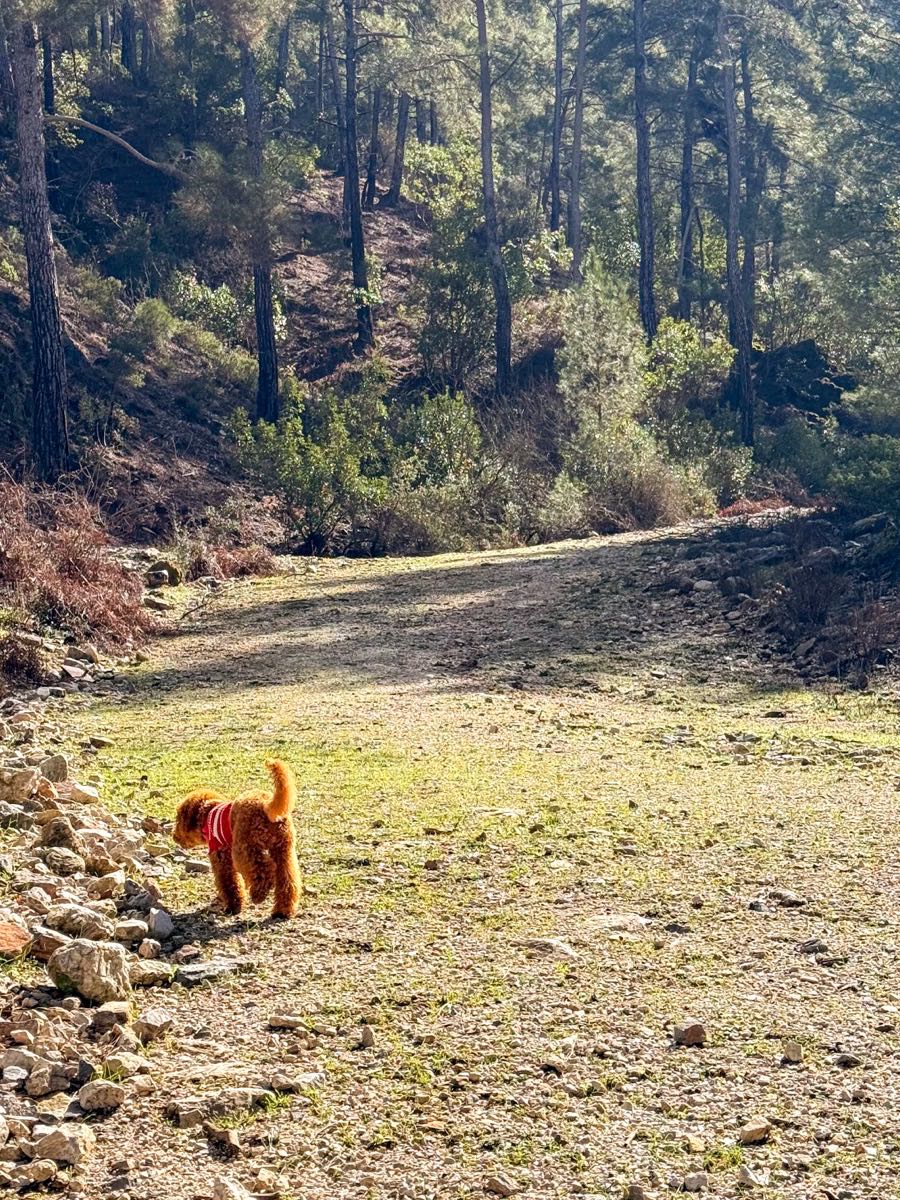
The short version
Walks go well when the gear is quietly right and the puppy gets to make small choices. Pick an anatomical harness that moves with the body, use a longer leash you keep loose, skip the retractable, introduce everything indoors first, and resize as your puppy grows. Do that, and "leash training" mostly takes care of itself. (And if you're at the very start of puppyhood, the wider week-by-week plan — vet visit, vaccines, feeding, records — is in The First 30 Days With a New Puppy.)
Quick gear checklist
- Anatomical, Y-shaped harness; two fingers under the straps
- Flat collar kept on for the ID tag
- A longer training leash (≈3, 5, or 10 m / 10, 15, or 30 ft), not just a 1.5 m one
- A sturdy, smooth-closing clip
- Skip the retractable leash for now
- Introduce harness + leash indoors before the first real walk
- Re-check the fit every couple of weeks and size up as needed